
Commercial roofs almost never fail all at once. They fail in slow motion, through a drain that stopped draining two seasons ago or a seam that opened an eighth of an inch after a hot July. By the time water reaches a ceiling tile, the damage has been spreading for months.
The insurance data backs this up. In The Hartford’s ten-year analysis of small-business claims, water and freezing damage climbed from 15% of claims in 2010–2014 to 20% in 2020–2024, making it the most common claim small-business owners file, at an average cost of $34,600 (The Hartford, December 9, 2025).
Here are the six problems we see most often on low-slope commercial roofs across southeastern and south central Indiana, and the specific thing that prevents each one.
Key Takeaways
- Water and freezing damage is now the most common small-business insurance claim, averaging $34,600 (The Hartford, 2025).
- Building code defines proper drainage as a roof that clears water within 48 hours of rainfall; anything longer counts as ponding.
- Hail drives as much as 80% of severe convective storm claims, and Indiana sits squarely in that exposure.
- Moisture inside the insulation raises heat loss long before it shows up as a ceiling stain.
1. Ponding Water and Blocked Drainage
If water is still sitting on your roof two days after a storm, that is ponding, and it is a code issue rather than a cosmetic one. The International Building Code defines positive roof drainage as drainage of the roof within 48 hours of precipitation, and sets a minimum design slope of one-quarter inch per foot for low-slope roofs (IIBEC, Wanda Edwards, PE, November 28, 2017).
Standing water is heavy, and the weight is the real danger: accumulation deflects the deck, the deflection deepens the basin, and the deeper basin holds more water. Edwards describes the progression as a life safety issue.
How to avoid it: Clear drains, scuppers, and gutters every spring and fall, and after any major storm. If the same low spot holds water every time, the fix is tapered insulation or an added drain, not another coat of sealant. Our siding and gutter services team handles the drainage side of this.
2. Failed Flashing, Seams, and Penetrations
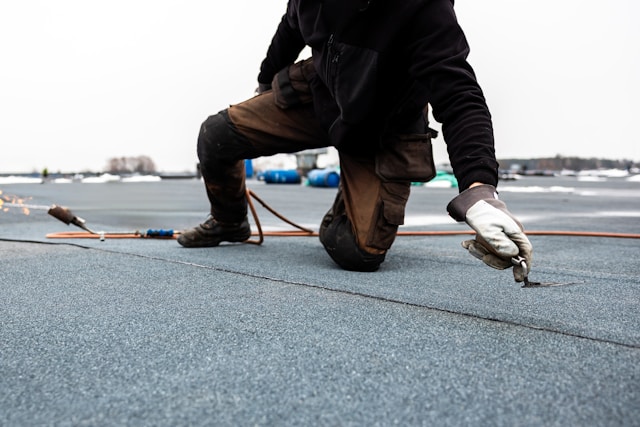
Most commercial roof leaks do not start in the middle of the field. They start where the membrane meets something else: a parapet wall, an HVAC curb, a vent stack, a skylight, or a seam between two sheets. Every penetration is a joint, and every joint is where thermal movement works the material loose.
Indiana’s temperature swing makes this worse. A dark membrane can move through a wide temperature range in a single summer day, cycling those seams thousands of times a year.
Water and freezing damage as a share of small-business insurance claims
Donut chart showing water and freezing damage accounts for 20 percent of small-business claims in 2020 to 2024, up from 15 percent in 2010 to 2014. Water and Freezing Damage: Share of Small-Business Claims 20% of all claims Up from 15% in 2010–2014 · Average claim $34,600 Source: The Hartford, analysis of 2020–2024 small-business claims, published December 9, 2025. How to avoid it: Have every penetration and termination inspected twice a year, and again after any roof-mounted equipment is serviced. HVAC technicians walking a roof are a common cause of new membrane damage, and it goes unreported because nobody saw it happen.
3. Storm and Hail Damage Nobody Documented
Indiana sits in an active severe-weather corridor, and the loss numbers have stayed high for three straight years. Severe convective storms drove $51 billion in U.S. insured losses in 2025, the third costliest year on record, and hail alone accounts for as much as 80% of severe convective storm claims in any given year (Triple-I, April 13, 2026).
Hail bruising on a membrane often leaves no visible hole. The mat fractures underneath, the roof keeps shedding water for another year or two, and by the time it opens up, the claim window has closed.
How to avoid it: Get a documented inspection after every significant hail or wind event, whether or not you see a leak. A dated report with photos is what makes a claim work later. For active damage, our emergency roofing services cover tarping and stabilization across the counties we serve.
[IMAGE: close-up of hail bruising on a single-ply membrane, with a coin or scale marker for size reference]
4. Trapped Moisture in the Insulation
A commercial roof leak damages the building twice: the ceiling and inventory you can see, and the insulation layer above, which holds water and quietly stops doing its job.
Recent testing in Insulation Outlook found that moisture-saturated insulation showed roughly a tenfold increase in thermal conductivity compared with dry insulation, producing about three times the heat loss, and cited earlier literature showing moisture as low as 5% can increase thermal losses by around 25% (Insulation Outlook, Rana and Brigham, May 1, 2026).
Relative heat loss through dry versus wet roof insulation
Horizontal bar chart comparing relative heat loss: dry insulation at 1 times, insulation with 5 percent moisture at about 1.25 times, and moisture-saturated insulation at about 3 times. Relative Heat Loss Through Roof Insulation Dry 1.0×
Source: Insulation Outlook, “Decreased Thermal Performance,” Rana and Brigham, May 1, 2026. How to avoid it: When a leak is repaired, insist the wet insulation is cut out and replaced rather than covered over. Patching the membrane above saturated insulation traps water against the deck, where it rots fasteners and steel. Our fire and water damage restoration crews handle that tear-out.
5. Freeze-Thaw Damage at Drains and Edges
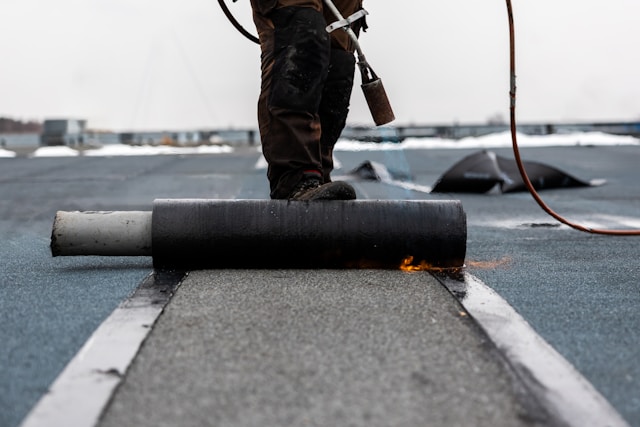
Indiana winters cross the freeze-thaw line repeatedly rather than staying frozen, and that cycling is harder on a roof than sustained cold. Water works into a seam during a thaw, freezes overnight, expands, and widens the opening a little more each time.
How to avoid it: Clear drains and scuppers before the first freeze, not after. Check that roof edges, coping, and downspouts are open and draining away from the building. If ice builds in the same place every winter, that spot has a drainage defect that will keep producing damage until it is corrected.
6. Reactive-Only Repairs With No Inspection Record
The most expensive commercial roofing problem is not a defect at all. It is the habit of calling a roofer only when something leaks, patching the one spot, and keeping no record of any of it.
Reactive management costs more three ways: emergency work is priced above scheduled work, repeated patching by different contractors creates a roof of mismatched materials nobody will warranty, and without dated records, storm claims are far harder to substantiate.
How to avoid it: Move to scheduled inspection with written documentation. Two visits a year plus post-storm checks gives you a maintenance history, a warranty trail, and a defensible claim file.
[IMAGE: a roofing technician documenting a roof condition on a tablet during a scheduled inspection]
What a Commercial Roof Inspection Program Looks Like
- Spring (March–May): Assess winter damage, clear drains, check seams and flashing opened by freeze-thaw, document spring storm damage.
- Fall (September–November): Clear debris before the first freeze, verify drainage runs clear, seal anything that will not survive winter.
- After every major storm: Photograph and date any damage, whether or not it is leaking yet.
- Ongoing: Keep every report in one file with warranty documents and the original roof specification.
CRF Roofing & Restoration has served Greensburg and southern Indiana for over 13 years as a family-owned, Owens Corning Preferred Contractor. See representative work in our project gallery or our roof installation and repair services.
Frequently Asked Questions
How often should a commercial roof be inspected?
Twice a year, plus after any significant hail or wind event. Spring and fall visits catch the two patterns that matter most in Indiana: freeze-thaw opening seams over winter, and debris blocking drainage before it. Post-storm checks matter separately, because hail damage often leaves no leak while still shortening the roof’s life.
Can a commercial roof leak be repaired, or does the whole roof need replacing?
It depends on the insulation, not the membrane. If the leak is recent and localized, cutting out the wet insulation and patching is usually right. If moisture has spread widely or the membrane is at end of life, patching only traps water against the deck. A moisture survey answers this before you spend money.
Does insurance cover commercial roof leaks?
Commercial property policies generally cover sudden and accidental damage, such as a storm opening the roof, but exclude gradual leaks and deferred maintenance. That distinction is why dated inspection records matter: they separate a covered storm event from wear the insurer will decline.
The Takeaway
Every problem here follows the same shape: something small stays unaddressed, water gets in, and the repair bill grows quietly until it becomes a replacement. All six are catchable on a twice-yearly schedule.
If you own or manage a commercial building in southeastern or south central Indiana and cannot remember your last formal roof inspection, that is where to start.
Schedule a free roof inspection with CRF Roofing & Restoration and get a dated, documented report on your building’s condition.